
Napa Records Open for Access
California law starts with access, but each Napa record set has its own keeper and limits. The Recorder-County Clerk controls recorded documents and local certificates. Napa Superior Court keeps case files. The Assessor, Tax Collector, GIS team, city Community Development staff, and county Planning, Building and Environmental Services each hold a different part of the property trail. The first check should identify the record, its custodian, and whether the online result is an index or the record itself.
| Napa record set | Official keeper | Web access | Coverage or limit |
|---|---|---|---|
| Deeds, liens, official filings | Recorder-County Clerk | Official Records Index | 1848 to current; limited index, images by subscription or copy request |
| Court cases | Napa Superior Court | Case Information Access Portal | Basic case data; confidential cases excluded |
| Parcel and tax records | Assessor and Tax Collector | Parcel and tax searches | Address or parcel search; owner name is not shown in the tax portal |
| Birth, death, marriage | Recorder-County Clerk and CDPH | Certificate order pages | Local event or license rules; authorized and informational copies differ |
| Permits and planning files | City Community Development or county PBES | eTRAKiT and PBES search | PBES digitization is incomplete and protected files are withheld |
| Custody and warrants | Napa County CJNet | Booking, custody, release, warrant reports | Current custody and recent report windows vary |
| Licenses and business filings | California boards and Secretary of State | Agency search portals | Coverage and displayed fields vary by license type |
Not all government information is open. Confidential court matters, sealed files, juvenile and adoption records, protected addresses, confidential marriages, and specified personal identifiers remain restricted. When only part of a file is exempt, the California Public Records Act calls for the non-exempt portion to be released after protected material is removed.
Napa Recorder Records Since 1848
The Napa County Official Records Index states that records may be viewed from January 1, 1848, through the current date. That depth is rare and supports both modern deed research and family or estate history. Yet the free display is only a catalog. The Recorder warns that an index should not be treated as the recorded document, while annual subscription access includes the index and document images. A copy request at the office is the practical path for most people who need the instrument rather than a name hit.
| Index control | Input type | Required | Use |
|---|---|---|---|
| Full Name | Text | Yes | Enter Last First Middle and try spelling variants |
| From Date | Date | No | Begin a range in mm/dd/yyyy form |
| To Date | Date | No | End the date range |
| Document Name | Result field | Not applicable | Identifies the visible public result |
A full-name search can point to deeds, liens, or other instruments. Search spelling variants and narrow broad results by date. Official-record copies cost $2 per page, and certification costs $5 per document. Filed maps use a separate search, with map pages priced at $4 and corner records free to print.
- Index
- A catalog that points to a filing but is not the filed document.
- Image
- A digital view of the recorded instrument, available through subscription or an office copy.
- Certified copy
- A copy authenticated by its custodian for an official purpose.
- Custodian
- The agency or office responsible for keeping and releasing a record.
- Exemption
- A rule that permits or requires information to be withheld from public release.
Napa Records Custodian Network
Napa is the county seat, and several key counters are close together, but they do not share one file system. The Recorder research counter handles recorded instruments and local vital certificates. Civil, family, and probate files go to the Historic Courthouse division; criminal and traffic records go to the Criminal Courthouse. Administrative files that are not already published can move through the county request portal.
Napa County Recorder-County Clerk
1127 1st Street, Suite A
Napa, CA 94559
707-253-4105
Civil, Family and Probate
825 Brown Street, 1st Floor
Napa, CA 94559
707-299-1140
Criminal and Traffic
1111 Third Street, 1st Floor
Napa, CA 94559
707-299-1180
Napa County Records Requests
Agency records not found in a published county portal
Online request channel
The Recorder lists research hours from 8 a.m. to 5 p.m. on weekdays, with shorter windows for recording and some purchase transactions. Calling the named division first can prevent a request from reaching the wrong keeper.
Napa Court Records Beyond Search
The Napa Superior Court portal gives basic case information and excludes confidential cases. It accepts a combined record number or name, or split last, first, middle, and suffix fields. Advanced controls can filter by party, business, case type, status, dates, judicial officer, and other identifiers. A docket, also called a register of actions, is the dated list of events in a case. It does not mean every filed document can be viewed from home.
When the portal lacks the needed result, send or deliver the correct civil, family, probate, or criminal request form. The clerk permits one name per search, treats each alias as a separate search, and caps daily work at ten names or ten cases. A search taking more than ten minutes costs $15. Copies are $0.50 per page, and a certified copy costs $40.
The Napa court records request page shows the division routes and copy rules before a form is filed.
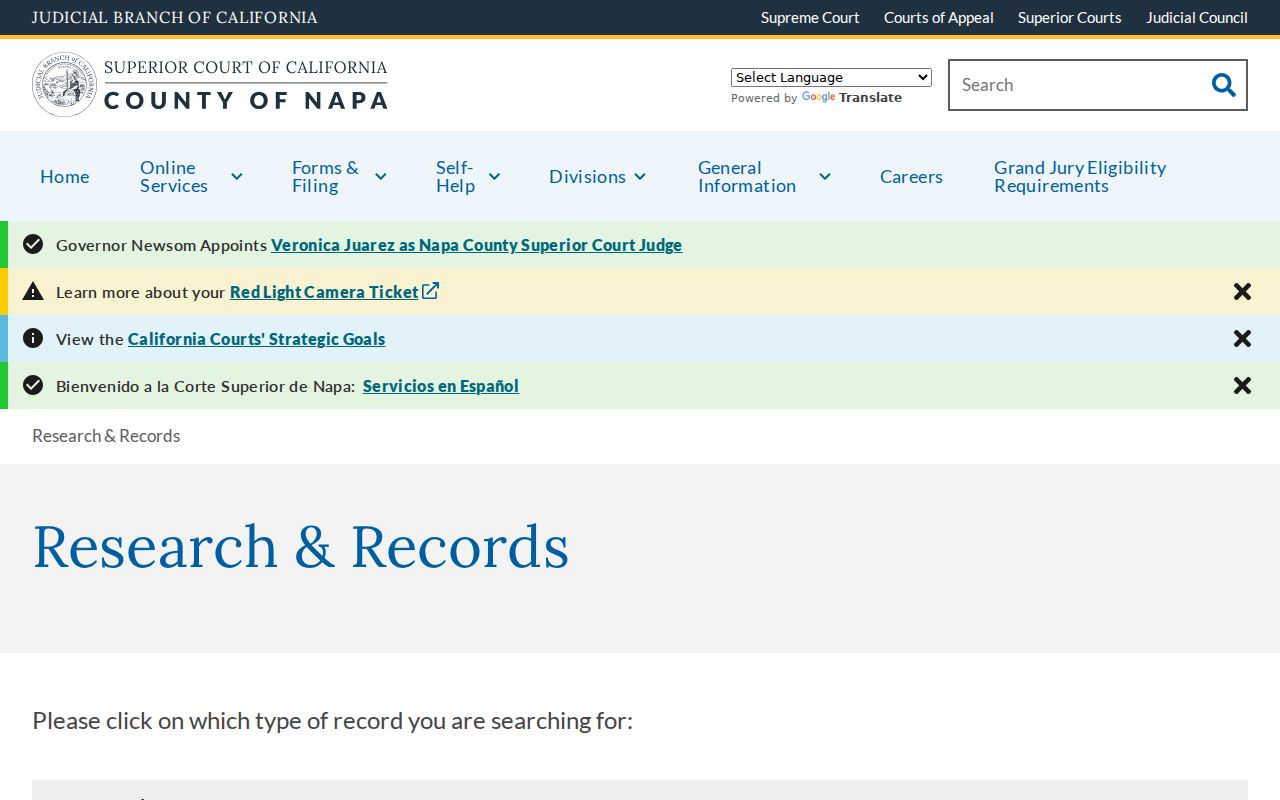
The captured page helps distinguish online case lookup from a clerk search for a file, image, or certified court copy.
Note: Juvenile, adoption, sealed, and other confidential matters require clerk review and may not be available to a general requester.
Napa Vital Records Copy Rules
Napa County issues birth and death certificates only for events in Napa County. It issues marriage certificates for licenses purchased in the county. Requests may be made in person, by mail, by fax, or through the county's approved online ordering channel. California Health and Safety Code section 103526 separates authorized copies from informational copies. An authorized copy requires an eligible relationship or status, and a mailed request needs a notarized sworn statement. An informational copy carries the same general record information but is marked as invalid for proving identity.
County fees are $34 for birth, $26 for death, and $19 for marriage certificates. The mail and fax form asks for the certificate type, names on the record, event place and date, parent names where relevant, number of copies, requester details, and payment. A confidential marriage certificate is not released to an unauthorized requester. Statewide certificates and amendments instead route through California Department of Public Health Vital Records.
The county's birth, death, and marriage certificate page lists local coverage, current fees, and each order channel.
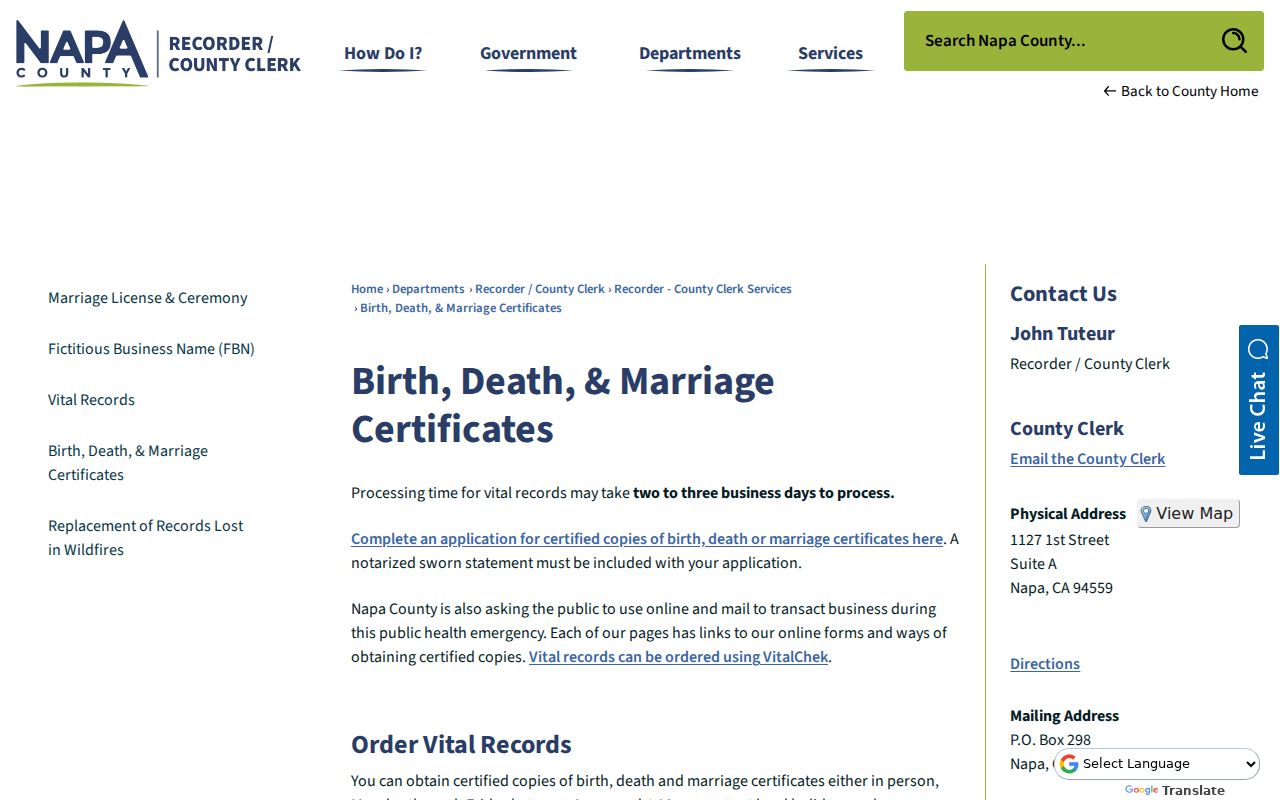
This source is the best checkpoint before choosing a county copy, a state copy, or a historical index.
Napa Property Records Reveal Less
The public Assessor form searches by fee parcel, assessment number, street address, or aircraft tail number. No owner-name field appeared in the inspected form. The Tax Collector likewise states that owner name and address are not displayed in its online results, even though the tax roll is public. Its search covers the current roll year plus historical choices from 2019 through 2025 and returns assessment, year, tax rate area, roll category, fee parcel, amount, and a details link.
For an address, use the Napa County Assessor parcel search to confirm the parcel, then the GIS map for district and spatial facts. Paid assessment data includes owner name and address for $18. The Recorder index supplies the stronger name-based deed trail. This split is important: an address result is not proof that the web tax screen will identify a person.
City permits are available through eTRAKiT. County PBES files have a different fallback because digitization is still underway. Search by parcel, street number and name, permit number, or establishment ID, then email or call PBES if expected records do not appear. Complaints, certain maps, and protected intellectual property are not displayed, though some materials may be viewed at the office.
Note: For past owners, pair the Recorder's name depth with Assessor and GIS parcel context instead of relying on one portal.
Napa Custody and Registry Records
Napa County CJNet publishes booking, in-custody, release, and active warrant information. Booking and release reports cover the past week, while the custody report reflects people held when the report data was produced. The warrant search uses a name and date of birth. State prison records use the California Department of Corrections and Rehabilitation search, and federal records from 1982 forward use the federal inmate locator.
California's offender registry is narrower than a full criminal history. State law controls which entries may be shown, and some registrants are not subject to public disclosure. The Department of Justice warns that name, age, and address similarities can cause mistaken identity. Registry information may be used for protection, not harassment or a crime.
The California registry disclosure and use notice explains those limits before a search begins.
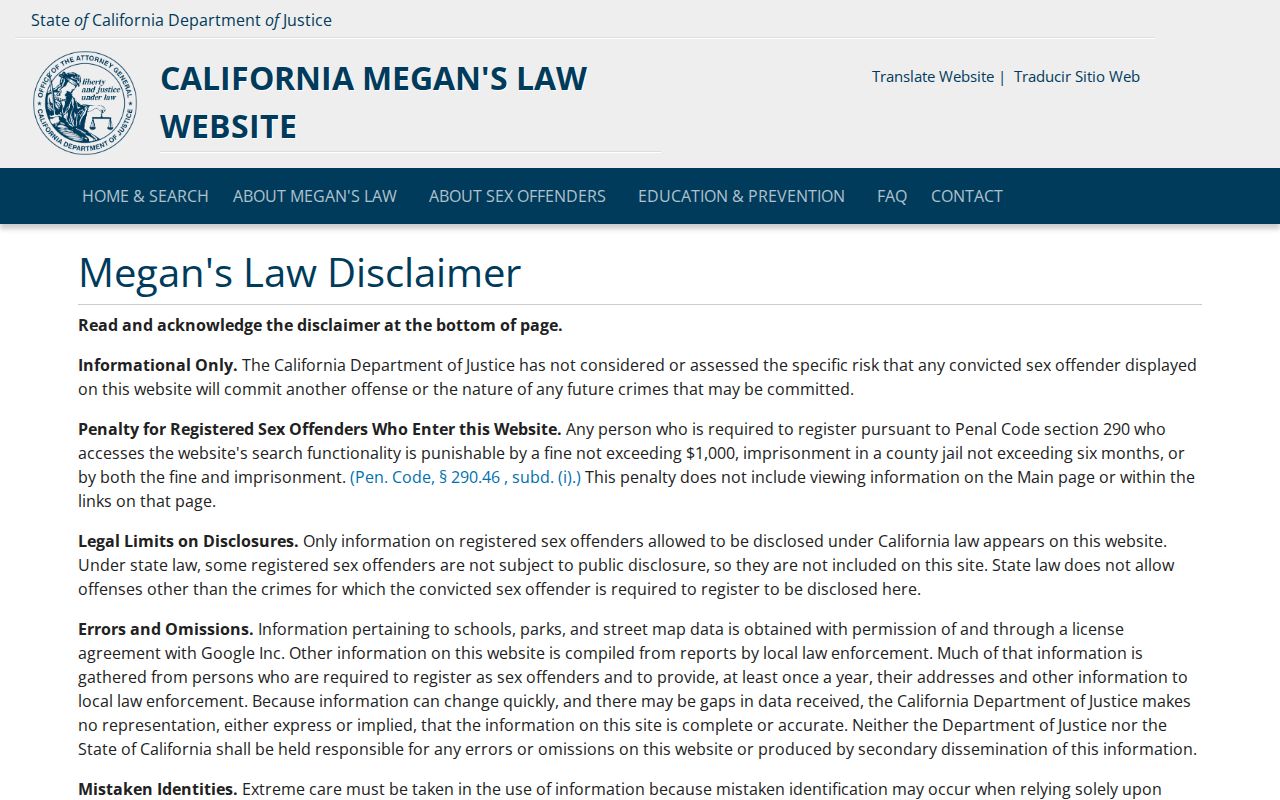
The notice is part of the official access path and should be read as carefully as any name result.
Use records lawfully. Never use Napa records to stalk, harass, threaten, or harm a person. Verify identity with the record custodian before drawing a conclusion.
Napa License Records Across California
Professional and business records often sit at the state level even when the person or premises is in Napa. The Department of Consumer Affairs search accepts a board or bureau, license type, license number, business name, first name, last name, and registry number. Results may indicate whether a license is current, expired, suspended, revoked, or subject to discipline. Some boards use their own systems, including contractor and real estate appraiser searches.
Napa's wine, dining, and visitor businesses also create useful records in the Alcoholic Beverage Control license lookup. Business entities and UCC notices are searched through the Secretary of State, while fictitious business name filings belong to the Napa County Clerk. These sources document different legal roles, so a business entity result does not replace a local FBN or an agency license.
The official California DCA License Search shows the name and license filters available for many regulated fields.
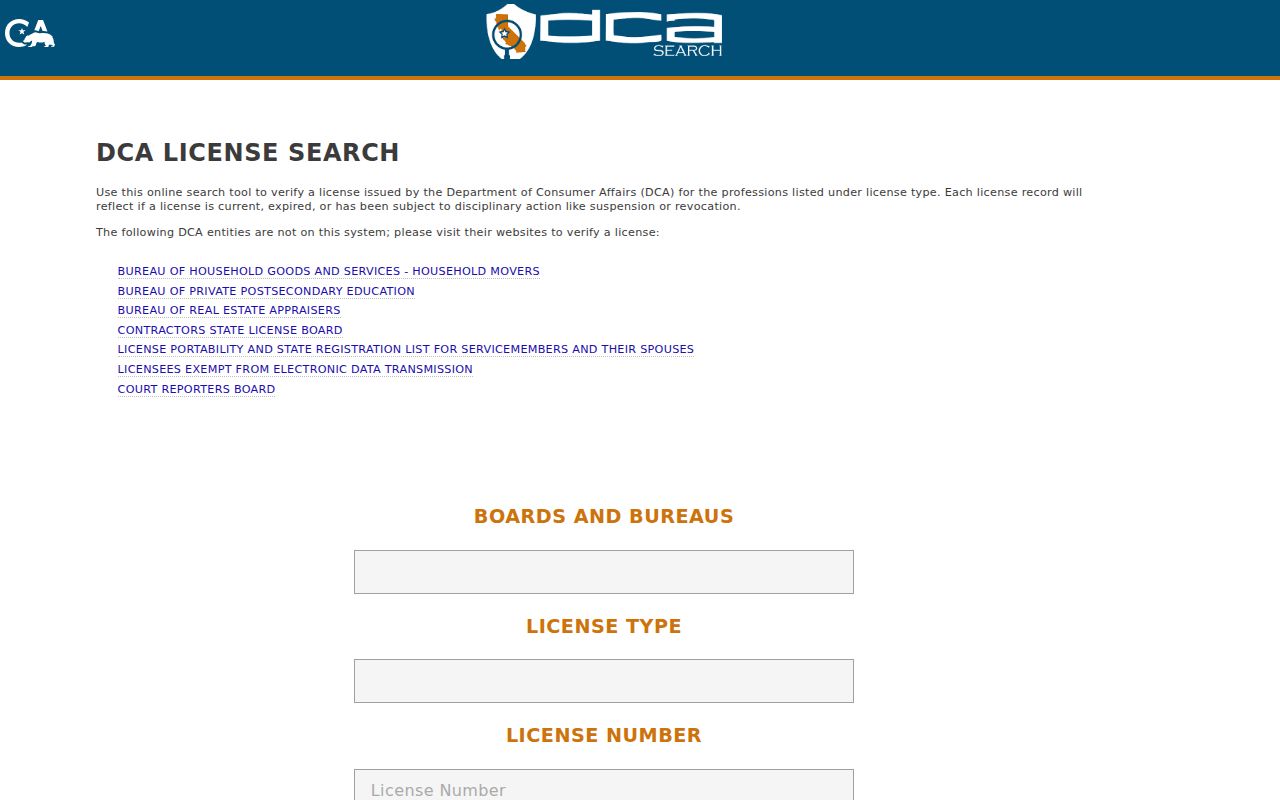
The search screen makes it possible to narrow a common name by board, license type, business, or number when those facts are known.
Napa Records Fees to Compare
Access to an index may be free while copies, certification, staff research, or a subscription carry a fee. Napa's largest listed charge is the $4,316 annual official-records subscription, which is meant for ongoing access to index data and document images. Most one-time needs are better served by the Recorder counter or a copy order. Court, assessor, map, vital, and business-name charges are separate because each office applies its own statute or schedule.
| Product or service | Published fee |
|---|---|
| Official-record copy | $2 per page |
| Recorder certification | $5 per document |
| Recorded or assessor map page | $4 |
| Assessor assessment data | $18 |
| Court copy | $0.50 per page |
| Court search over ten minutes | $15 |
| Certified court copy | $40 |
| Fictitious business name search | $9 |
Under state access law, ordinary agency charges generally track direct duplication cost or a fee set by another law. Routine review, search, and redaction time is not automatically billable. Ask for an estimate when page count or certification needs are unclear.
Restricted Napa Public Records
Open government law does not turn every personal detail into an unrestricted file. Napa court search excludes confidential matters. Vital copies use eligibility rules. Voter registration data requires an approved purpose, application, identification, fee, and security promises, rather than a browse-anyone roll. The detailed process belongs with Napa voter records. Tax search results suppress owner name and address, and PBES withholds complaints and specified protected materials from its public display.
Safe at Home gives eligible Californians a substitute mailing address and special confidential channels. Participants include survivors of stalking, domestic violence, sexual assault, human trafficking, child abduction, and other covered harms. State, county, and city agencies accept the substitute address. A participant should use confidential voter registration procedures rather than a standard online registration form.
Redaction is another form of limited access. An office may remove a protected identifier, address, signature, or exempt passage while releasing the rest. A requester can ask for the segregable, non-exempt portions if a full file cannot be disclosed.
Napa Records Guard Against Fraud
In April 2026, the Napa County Recorder announced a free Guard Dog notification service. A user can register a name or property and receive an email when a recorded document may match it. Alerts can involve deeds, liens, loan or refinance papers, and other real estate filings. The alert does not stop a recording and does not prove fraud, but it gives the owner a prompt to inspect the official filing.
The timing matters. One month earlier, Napa County warned that scammers were impersonating county staff and seeking payment from people with pending planning applications. Some victims lost thousands of dollars. Treat an unexpected payment demand as unverified, avoid the message's links and phone numbers, and contact the named county department through its official page.
Note: A fraud alert is an early warning, while the Recorder's filed document remains the source to review and verify.
Request Napa Public Records
California's open-records law permits any person to ask for reasonably described agency records. Napa agencies must make non-exempt files promptly available and decide within ten days whether a request seeks disclosable material. Unusual circumstances can support a written extension of up to fourteen days. A denial must be written, state the reasons, and identify the responsible officials. If a record is already online, the agency may point to it, but it must provide a copy when the requester cannot access or reproduce the online version.
A focused request is easier to route and less likely to produce needless delay. Use the record name, date range, department, parcel, case number, or other known identifier. Do not ask NextRequest for a court file, certificate, or Recorder image when a distinct clerk form or copy channel controls it.
- Name the custodian. Decide whether the record belongs to the city, county, court, Recorder, or a California agency.
- Check published access. Search the official index or department page and note what the web result leaves out.
- Describe the file. Give a tight date range, subject, department, record type, and known identifier without demanding a new analysis.
- Choose the proper channel. Use NextRequest for county administrative files, the court's division form for case records, or the Recorder's counter, mail, fax, and copy process.
- Review the response. Pay valid copy or certification charges, ask for segregable portions, or narrow the wording if the office identifies a problem.
The Napa County NextRequest portal is the documented fallback for county records that are not already available through a purpose-built database.
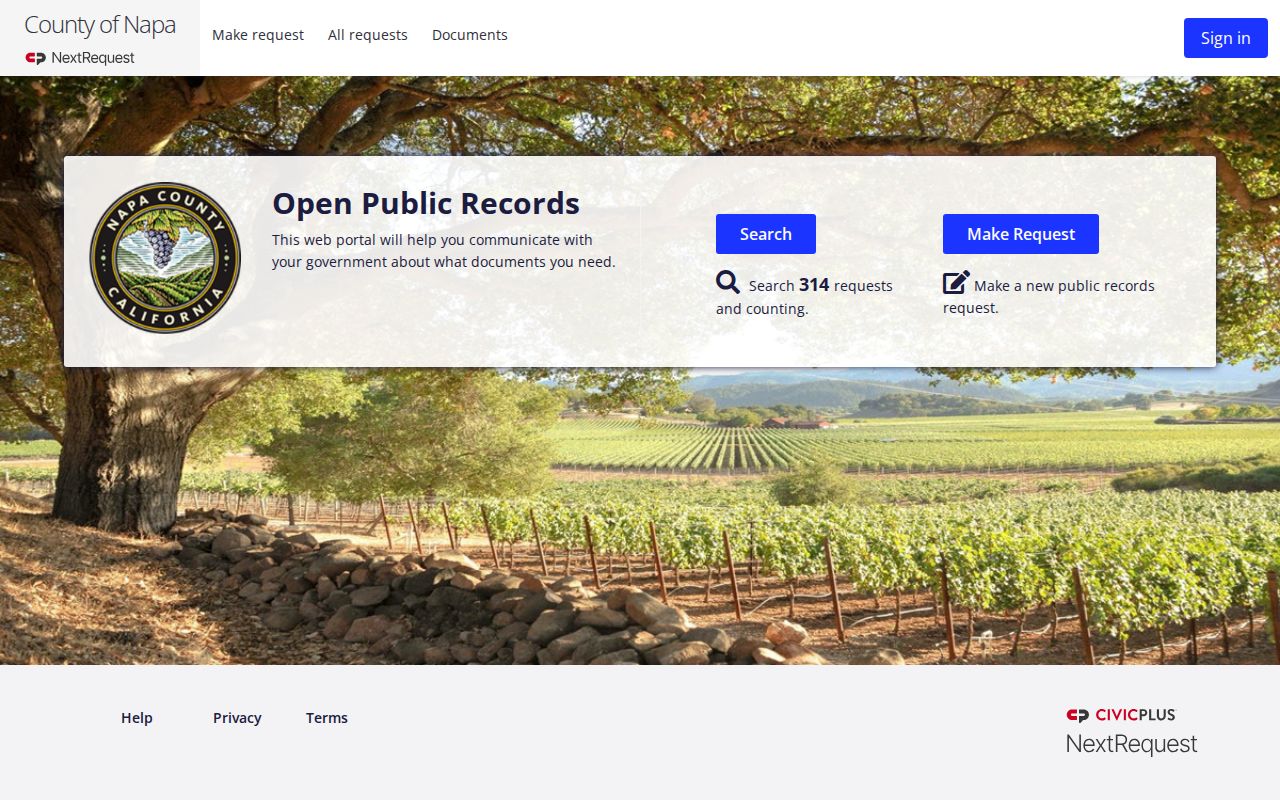
The request portal preserves a public request trail and routes submissions, while specialized records still stay with their named custodians.
Before submitting. Ask for an existing record, not an answer to a broad question, and state whether an electronic copy will meet the need.